
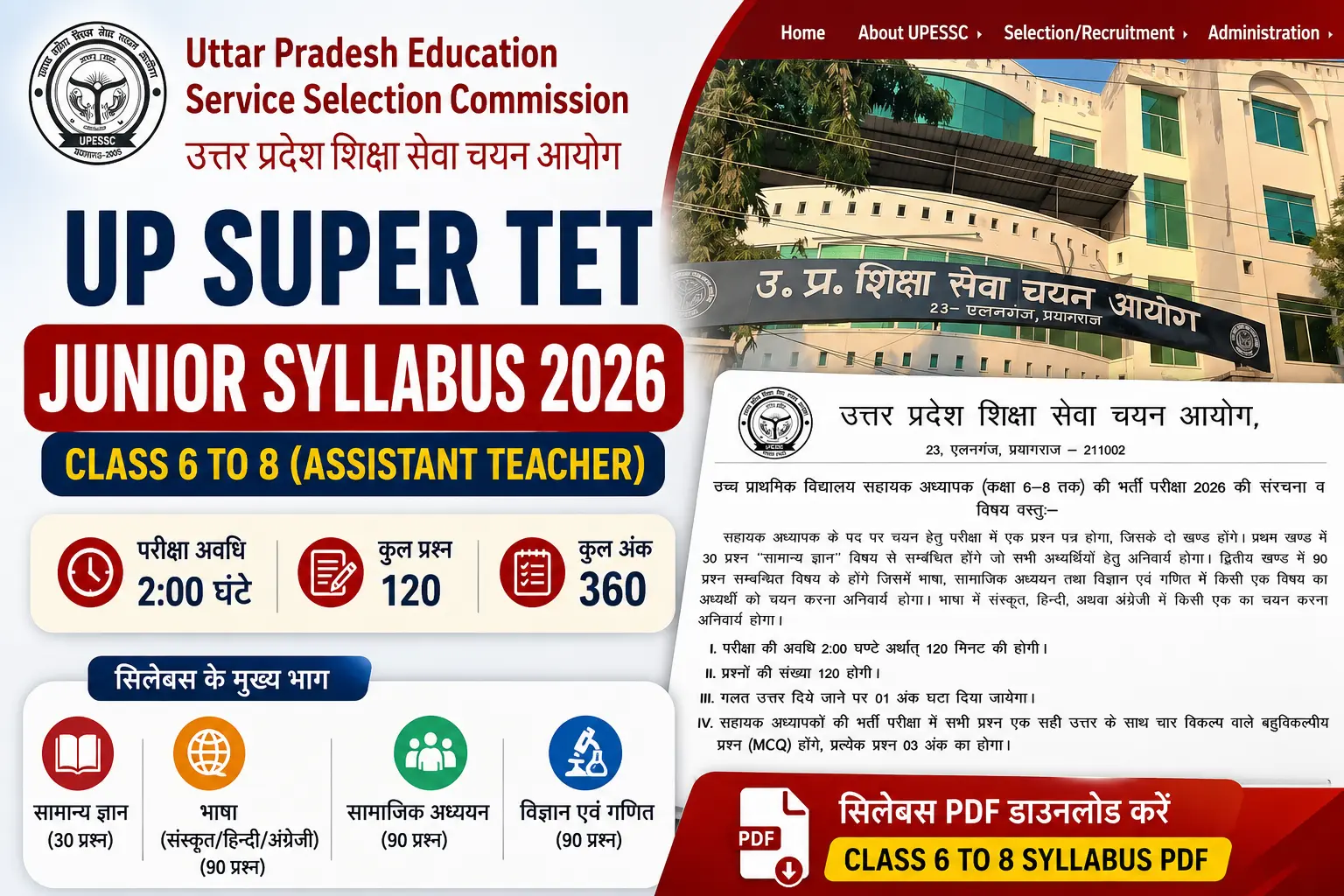
The Uttar Pradesh Education Service Selection Commission (UPESSC) has released the UP Super TET Syllabus 2026 for the upcoming Assistant Teacher recruitment examination. The syllabus is available for candidates preparing for both Primary Level (Class 1 to 5) and Junior Level (Class 6 to 8) posts.
This article focuses on the UP Super TET Junior Syllabus 2026, including the exam pattern, subject-wise syllabus, marking scheme and syllabus PDF download details.
For Junior Level Assistant Teacher recruitment, the examination is divided into two sections. The first section contains 30 questions from General Knowledge, which is compulsory for all candidates. In the second section, candidates have to choose one of the prescribed subject groups according to the teaching post.
Important: The official UPESSC website confirms that the Commission handles recruitment for Assistant Teachers in Junior High Schools and other education departments. However, the direct syllabus PDF is not currently exposed in the searchable section of the official website. The detailed syllabus below is based on the currently available 2026 syllabus material and should be checked against the applicable official notification before final preparation.
UP Super TET Junior Syllabus 2026 Overview
| Particulars | Details |
|---|---|
| Exam Name | UP Super TET Assistant Teacher Recruitment Exam 2026 |
| Level | Junior Level |
| Classes | 6th to 8th |
| Conducting Authority | Uttar Pradesh Education Service Selection Commission |
| Total Questions | 120 |
| Marks Per Question | 3 |
| Total Marks | 360 |
| Exam Duration | 2 Hours |
| Question Type | Multiple Choice Questions |
| Negative Marking | 1 mark for each wrong answer |
| Paper Language | Hindi and English |
| Section I | General Knowledge, 30 Questions |
| Section II | Selected Teaching Subject, 90 Questions |
| Official Website | upessc.up.gov.in |
UP Super TET Junior Exam Pattern 2026
The Junior Level examination consists of 120 multiple-choice questions. Each question carries 3 marks, making the total paper worth 360 marks.
The examination duration is 120 minutes, and negative marking of 1 mark is applicable for an incorrect answer.
Section-Wise Exam Pattern
| Section | Subject | Questions | Marks |
|---|---|---|---|
| Section I | General Knowledge | 30 | 90 |
| Section II | Selected Teaching Subject | 90 | 270 |
| Total | 120 | 360 |
Candidates have to choose one option in Section II according to the teaching category for which they are applying.
Section II Options
Candidates can choose one of the following:
- Language Teacher: Sanskrit, Hindi or English, any one
- Social Studies Teacher: Social Studies
- Science & Mathematics Teacher: Science and Mathematics
The selected subject section contains 90 questions.
UP Super TET Junior Syllabus 2026 Subject-wise
The syllabus for UP Super TET Junior Exam is divided into General Knowledge and a subject-specific section. Candidates should prepare the topics according to the teaching subject they choose.
1. General Knowledge, Current Affairs & Reasoning
General Knowledge is the compulsory section for all Junior Level candidates.
| Subject Area | Important Topics |
|---|---|
| Current Affairs | National current affairs, international current affairs, important national and international events, awards, important observance days, national security, foreign policy, road and traffic safety |
| Indian History | Ancient Indian history, important historical events, Indian National Movement, freedom movement, major developments before independence, important personalities and events |
| Indian Geography | Earth and Solar System, movements of the Earth, globe and maps, physical features, lithosphere, atmosphere, hydrosphere, climate, natural resources |
| Indian Polity & Governance | Indian Constitution, political system, Central and State Government, democracy, Panchayati Raj, governance, public policy, district administration, rural and urban administration |
| Economy & Social Development | Indian economy, economic development, sustainable development, poverty, population, urbanisation, social development, industries, economic resources |
| Environment & General Science | Environment and ecology, biodiversity, pollution, natural resources, waste management, climate change, general science |
| Reasoning | Analogy, classification, coding-decoding, coded inequalities, assertion and reason, binary logic, clocks and calendars, logical relationships |
2. Hindi Syllabus
Candidates choosing Hindi as their Language Teacher subject should prepare the following topics:
| Area | Topics to Prepare |
|---|---|
| Language | History of Hindi language |
| Literature | History of Hindi literature |
| Grammar | Hindi grammar |
| Comprehension | Unseen prose passages, unseen poetry passages |
| Literary Knowledge | Important writers, important poets, major literary works |
| General Understanding | Basic understanding of Hindi language and literature |
3. English Syllabus
| Area | Topics to Prepare |
|---|---|
| Language | History of English language |
| Literature | History of English literature |
| Grammar | English grammar |
| Comprehension | Unseen passages, reading comprehension |
| Literary Knowledge | Important writers, important poets, major literary works |
4. Sanskrit Syllabus
| Area | Topics to Prepare |
|---|---|
| Language | History of Sanskrit language |
| Literature | History of Sanskrit literature |
| Grammar | Sanskrit grammar |
| Comprehension | Unseen prose passages, unseen poetry passages |
| Literary Knowledge | Important writers, important poets, major Sanskrit works |
5. Social Studies Syllabus
Social Studies is the 90-question subject option for candidates applying under the Social Studies Teacher category.
History
| Topic | Important Areas |
|---|---|
| Early History | Sources of History, Stone Age, Chalcolithic culture, Vedic culture, India in the 6th century BCE |
| Ancient India | Early Indian kingdoms, Maurya Empire, Post-Mauryan India, Gupta period |
| Medieval India | Rajput period, advent of Islam in India, Delhi Sultanate, Mughal Empire, Mughal culture and decline |
| Modern India | Arrival of European powers, British rule in India, rise of nationalism, Indian freedom movement |
| Post-Independence India | Independence and Partition, challenges faced by independent India |
Indian Constitution & Civics
| Topic | Important Areas |
|---|---|
| Constitution | Indian Constitution, democracy in India |
| Government | Central government, State government, governance system |
| Administration | District administration, rural society, urban society |
| Local Government | Local self-government, Panchayati Raj |
| Other Areas | National security, foreign policy, civil defence, traffic safety, disability-related issues |
Geography
| Topic | Important Areas |
|---|---|
| Earth & Space | Earth and Solar System, movements of the Earth |
| Maps | Map making |
| Physical Geography | Lithosphere, atmosphere, hydrosphere |
| India | Major physical features of India, soil, vegetation, wildlife, climate |
| Uttar Pradesh | Geography of Uttar Pradesh |
| Resources & Economy | Agriculture, minerals, industries |
| Population | Population and urbanisation |
Environment
| Topic | Important Areas |
|---|---|
| Resources | Natural resources |
| Protection | Environmental protection |
| Pollution | Different types of pollution |
| Waste | Waste management |
| Ecology | Ecology and environment |
| Current Topics | Important environment-related events, awards and observance days |
6. Mathematics Syllabus
Mathematics is included under the Science and Mathematics Teacher option.
| Topic | Important Areas |
|---|---|
| Number System | Natural numbers, whole numbers, integers, rational numbers, irrational numbers, LCM, HCF |
| Arithmetic | Ratio and proportion, percentage, profit and loss, simple interest, compound interest, square roots, cube roots |
| Algebra | Algebraic expressions, algebraic identities, exponents, linear equations, quadratic equations, simultaneous equations |
| Geometry | Parallel lines, triangles, quadrilaterals, construction of triangles and quadrilaterals, circles, cyclic quadrilaterals, tangents |
| Statistics & Data | Classification of data, frequency, pictographs, mean, median, mode, bar graphs, pie charts |
| Probability | Basic probability |
| Mensuration | Mensuration-related problems |
| Trigonometry | Basic trigonometry |
7. Science Syllabus
Science is also covered under the Science and Mathematics Teacher option.
General Science
| Topic | Important Areas |
|---|---|
| General Science | Science in daily life, important discoveries, science and technology |
Biology
| Topic | Important Areas |
|---|---|
| Living World | Living and non-living things, classification of living organisms |
| Human & Animal Biology | Structure and functions of animals, cells, organ systems |
| Microorganisms | Microorganisms, diseases and prevention |
| Health | Adolescence, food and nutrition, health and hygiene |
| Agriculture | Crop production, nitrogen cycle |
| Human Processes | Reproduction, respiration, excretion |
| Nutrition & Regulation | Vitamins, hormones, mineral salts |
| Blood | Blood composition and precautions in blood transfusion |
Physics
| Topic | Important Areas |
|---|---|
| Measurement & Motion | Measurement, motion, force |
| Electricity & Magnetism | Electric current, magnetism, static electricity |
| Machines & Energy | Simple machines, energy |
| Sound & Light | Sound, light, optical instruments |
Chemistry & Environment
| Topic | Important Areas |
|---|---|
| Air & Water | Air and water, air and water pollution, conservation of water |
| Matter | Properties and composition of matter |
| Acids & Bases | Acids, bases and salts |
| Heat | Heat and temperature |
| Materials | Minerals and metals, carbon and its compounds, plastic, glass, soap and clay |
| Energy | Alternative sources of energy |
| Periodic Table | Periodic table |
| Environment | Pollution and conservation-related topics |
Note: The tables above organize the topics from the currently available Junior Level syllabus material. Candidates should also check the applicable official UPESSC notification/syllabus for any later changes before starting final preparation.
UP Super TET Junior Syllabus PDF 2026
Candidates preparing for the Class 6 to 8 Assistant Teacher examination can use the available UP Super TET Junior Syllabus PDF for detailed preparation.
Download: UP Super TET Junior Level Syllabus PDF
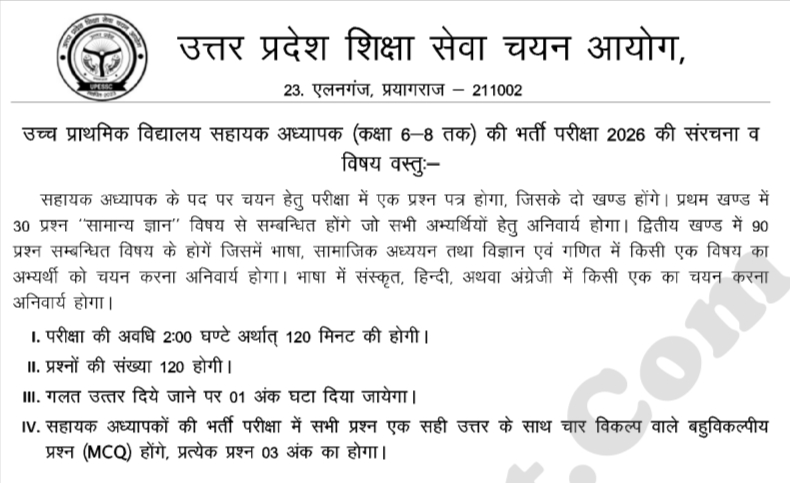
The PDF available at this link is a 4-page document containing the Junior Level syllabus material.
UP Super TET Primary vs Junior Syllabus
The Primary and Junior Level papers are structured differently.
| Particulars | Primary Level | Junior Level |
|---|---|---|
| Classes | 1 to 5 | 6 to 8 |
| Total Questions | 120 | 120 |
| Total Marks | 360 | 360 |
| Duration | 120 Minutes | 120 Minutes |
| Section Structure | Multiple subject areas | GK + Selected Teaching Subject |
| Compulsory Section | General Knowledge and other areas | General Knowledge |
| Subject Choice | Primary syllabus | Language / Social Studies / Science & Mathematics |
For Junior Level candidates, the 90-question subject section is particularly important because it accounts for the majority of the paper.
How to Prepare for UP Super TET Junior Exam 2026
Candidates can make their preparation more effective by dividing the syllabus into two parts.
Step 1: Complete General Knowledge
Since General Knowledge is compulsory, prepare it regularly rather than leaving it for the end.
Focus on:
- Current affairs
- Indian history
- Geography
- Constitution and polity
- Economy
- Environment
- General science
- Reasoning
Step 2: Focus on Your Selected Subject
The second section contains 90 questions, so candidates should give substantial preparation time to their selected subject.
For example:
- Language Teacher → Hindi/English/Sanskrit
- Social Studies Teacher → Social Studies
- Science & Maths Teacher → Science and Mathematics
Step 3: Practice MCQs
The examination is objective in nature. Regular MCQ practice can help improve both speed and accuracy.
Step 4: Revise Short Notes
Prepare short revision notes for:
- Important dates
- Historical events
- Constitutional facts
- Geography
- Science concepts
- Current affairs
- Formulas and numerical concepts
Step 5: Avoid Blind Guessing
With 1 mark negative marking, candidates should be careful while attempting questions where they are completely unsure of the answer.
Important Links
| Description | Link |
|---|---|
| Junior Level Syllabus PDF | Download PDF |
| Primary Level Syllabus PDF | Download PDF |
| UPESSC Official Website | www.upessc.up.gov.in |
| Assistant Teachers Exam Syllabus | Download Here |
General Queries
What is the UP Super TET Junior Syllabus 2026?
The UP Super TET Junior syllabus is the prescribed subject-wise preparation outline for Assistant Teacher recruitment for the Class 6 to 8 level.
How many questions are asked in UP Super TET Junior Exam?
The Junior Level paper contains 120 questions, and the examination duration is 2 hours (120 minutes).
How many marks is the UP Super TET Junior paper?
Each question carries 3 marks, making the total paper 360 marks.
Is there negative marking in UP Super TET Junior?
Yes. The currently available syllabus material specifies a 1-mark deduction for each incorrect answer.
How many questions are asked from General Knowledge?
There are 30 General Knowledge questions in the compulsory first section.
How many questions are asked from the selected subject?
The second section contains 90 questions from the selected teaching subject/category.
Which subjects can I choose in Section II?
Candidates can choose from the applicable options of Language, Social Studies, or Science and Mathematics, depending on the teaching post. Language candidates can choose Hindi, English or Sanskrit.
Where can I download the UP Super TET Junior Syllabus PDF?
The currently available Junior Level syllabus PDF can be accessed from the download link provided in this article. Candidates should also check the official UPESSC portal for the applicable final notification and syllabus.
Disclaimer: JobAlertFree.in provides exam and recruitment updates to aspiring aspirants for informational purposes only. Candidates should verify the latest syllabus, examination pattern, eligibility and other details from the official UPESSC website and applicable recruitment notification before beginning or finalising their preparation.