
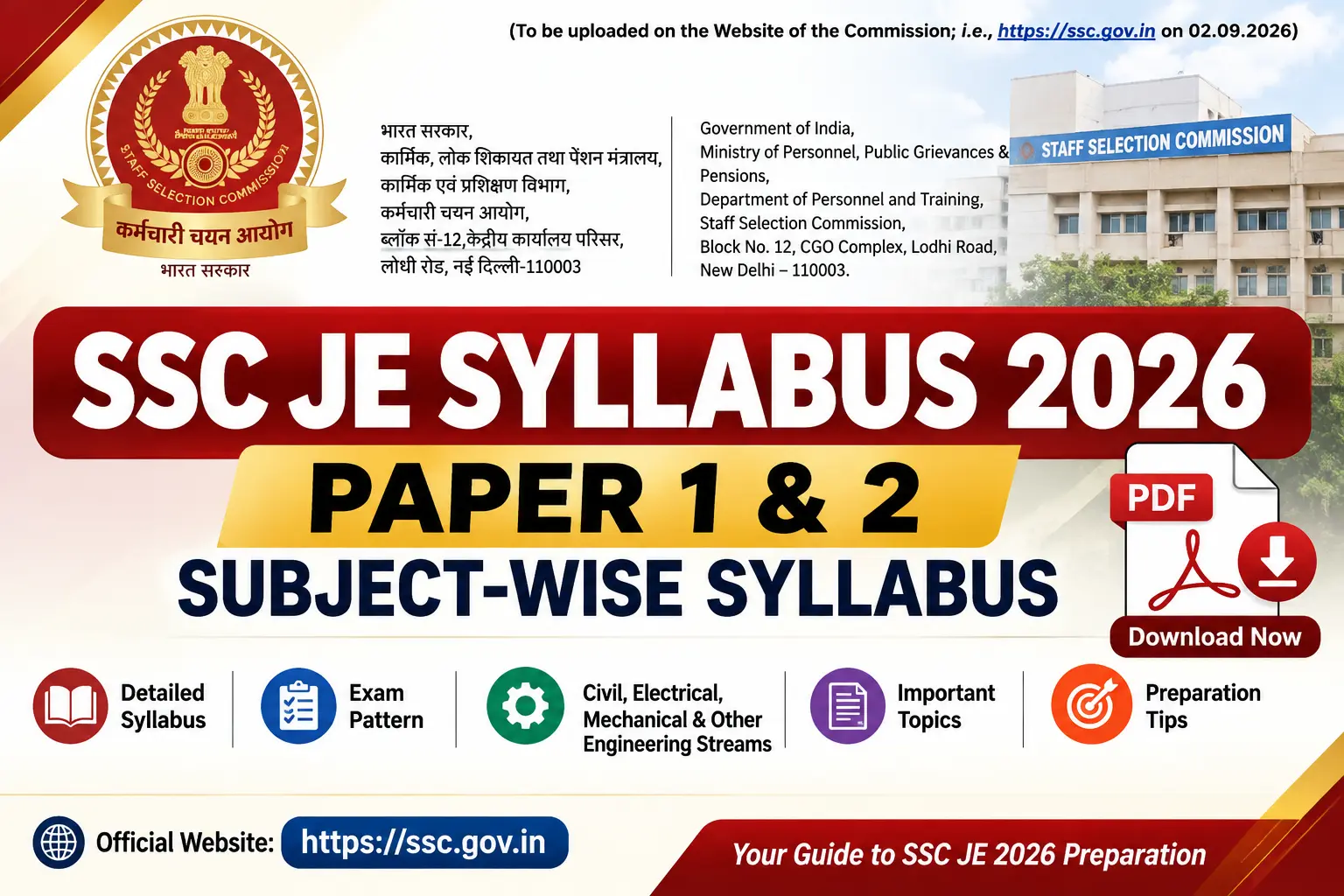
SSC JE Syllabus 2026 covers General Intelligence & Reasoning, General Awareness, and technical engineering subjects. The technical syllabus depends on the candidate’s eligible engineering stream, such as Civil, Electrical, Mechanical, Computer Science & IT, Electronics & Telecommunication, Physics, or Telecommunication Engineering.
Candidates preparing for the SSC Junior Engineer Examination 2026 should understand the Paper 1 and Paper 2 syllabus before starting their preparation. Below, we have provided the SSC JE syllabus in an easy-to-understand format, including the major topics for each engineering stream.
SSC JE Syllabus 2026 Overview
| Particular | Details |
|---|---|
| Exam Name | SSC Junior Engineer Examination 2026 |
| Conducting Authority | Staff Selection Commission (SSC) |
| Papers | Paper 1 and Paper 2 |
| Exam Mode | Computer-Based Examination |
| Paper 1 Subjects | General Intelligence & Reasoning, General Awareness, Relevant Technical Subject |
| Paper 2 Subject | Relevant Technical Engineering Subject |
| Technical Streams | Civil & Structural, Electrical, Mechanical, Computer Science & IT, Electronics & Telecommunication, Physics, Telecommunication |
| Question Type | Objective Type Questions |
| Official Website | ssc.gov.in |
SSC JE Paper 1 Syllabus 2026
Paper 1 consists of General Intelligence & Reasoning, General Awareness, and the relevant technical subject. Applicants have to attempt the technical subject applicable to their post and qualification.
| Section | Important Topics |
|---|---|
| General Intelligence & Reasoning | Analogies, similarities and differences, space visualization, problem-solving, analysis, judgment, decision-making, visual memory, discrimination, observation, relationship concepts, arithmetical reasoning, classification, number series, abstract ideas and symbols |
| General Awareness | Current events, History, Culture, Geography, Economic Scene, General Polity, Scientific Research, India and neighbouring countries |
| Technical Subject | Civil & Structural, Electrical, Mechanical, Computer Science & IT, Electronics & Telecommunication, Physics, or Telecommunication Engineering, according to the applicable post |
SSC JE Paper 1 Technical Syllabus
The technical syllabus is divided into seven parts. Candidates should prepare the part that matches their post and educational qualification.
| Part | Engineering Subject | Major Topics |
|---|---|---|
| Part A | Civil & Structural Engineering | Engineering Mechanics, Solid Mechanics, Structural Analysis, Construction Materials, Estimating, Costing & Valuation, Concrete Structures, Steel Structures, Surveying, Soil Mechanics, Fluid Mechanics, Hydraulics, Hydrology, Irrigation, Environmental Engineering, Transportation Engineering |
| Part B | Electrical Engineering | Electrical Engineering Fundamentals, Magnetic Circuits, AC Fundamentals, Measurements, Electrical Machines, Synchronous Generators, Generation, Transmission & Distribution, Estimation & Costing, Utilization of Electrical Energy, Basic Electronics, Power Electronics |
| Part C | Mechanical Engineering | Engineering Mechanics, Strength of Materials, Theory of Machines, Machine Design, Materials Science, Thermal Engineering, Fluid Mechanics, Hydraulic Machinery, Industrial Engineering, Manufacturing Engineering, Metrology, Advanced Manufacturing Processes |
| Part D | Computer Science & Information Technology | Engineering Mathematics, Digital Logic, Computer Organization, Programming & Data Structures, Algorithms, Theory of Computation, Compiler Design, Operating System, Databases, Computer Networks |
| Part E | Electronics & Telecommunication Engineering | Electronics, Electronic Components, Diodes, Transistors, Amplifiers, Oscillators, Voltage Regulation, Network Theorems, AC Circuits, Three-Phase Circuits, Digital Electronics, Antennas, Modulation, Multiplexing, Digital Communication, RF Communication, Wireless Telecommunications |
| Part F | Physics | Mathematical Methods, Mechanics, Properties of Matter, Oscillations, Waves, Optics, Electricity, Magnetism, Kinetic Theory, Thermodynamics, Modern Physics, Solid State Physics, Semiconductor Devices, Analog & Digital Electronics |
| Part G | Telecommunication Engineering | Engineering Mathematics, Network Analysis, Signals & Systems, Electronic Devices, Analog Circuits, Digital Circuits, Control Systems, Analog Communication, Digital Communication, Electromagnetics |
SSC JE Paper 2 Syllabus 2026
Paper 2 is the technical paper for candidates shortlisted after Paper 1. Applicants have to attempt the same technical subject or stream selected in the application form, according to their eligibility.
| Part | Paper 2 Subject |
|---|---|
| Part A | Civil & Structural Engineering |
| Part B | Electrical Engineering |
| Part C | Mechanical Engineering |
| Part D | Computer Science & Information Technology |
| Part E | Electronics & Telecommunication Engineering |
| Part F | Physics |
| Part G | Telecommunication Engineering |
For Civil, Mechanical and Electrical Engineering, the level of technical questions is approximately at the Diploma level. For Computer Science & IT, Electronics & Telecommunication Engineering, Physics, and Telecommunication Engineering, the questions are approximately at the Graduation level.
SSC JE Civil Engineering Syllabus 2026
Aspirants appearing for the Civil Engineering stream should prepare the following major areas:
| Subject | Major Topics |
|---|---|
| Building Materials | Properties, classification, testing, manufacture and uses of materials, timber, wood-based products, paints, varnishes, laminates |
| Estimating, Costing & Valuation | Estimates, rate analysis, earthwork, brickwork, RCC work, shuttering, painting, flooring, plastering, water tanks, bar bending schedule, depreciation and valuation |
| Surveying | Chain surveying, compass surveying, plane table surveying, levelling, contouring, theodolite, tachometric surveying, advanced surveying equipment |
| Soil Mechanics | Origin of soil, phase diagram, void ratio, density, grain size distribution, Atterberg limits, soil classification, permeability, compaction, bearing capacity, standard penetration test |
| Hydraulics | Fluid properties, hydrostatics, flow measurement, Bernoulli’s theorem, pipe flow, open channels, weirs, flumes, spillways, pumps and turbines |
| Irrigation Engineering | Irrigation methods, hydrology, rainfall, crop water requirement, duty, delta, canals, weirs, barrages, flood control, waterlogging, land reclamation and irrigation projects |
| Transportation Engineering | Highway engineering, pavement materials, flexible and rigid pavements, railway engineering, permanent way, traffic surveys, signals, signs and road safety |
| Environmental Engineering | Water supply, water purification, distribution, sanitation, sewerage, sewage treatment, drainage, solid waste management, air pollution and noise pollution |
| Structural Engineering | Theory of Structures, Concrete Technology, RCC Design and Steel Design |
The source material also provides detailed Civil Engineering topics for Paper 2, including RCC beams and slabs, concrete mix design, steel structures, retaining walls, columns, staircases, and other structural components.
SSC JE Electrical Engineering Syllabus 2026
| Subject | Major Topics |
|---|---|
| Electrical Fundamentals | Basic electrical concepts and fundamentals |
| Magnetic Circuits | Magnetic circuits and related concepts |
| AC Fundamentals | Alternating current fundamentals |
| Measurements | Electrical measurement and measuring instruments |
| Electrical Machines | Electrical machines and special electric machines |
| Generation | Electrical power generation |
| Transmission & Distribution | Transmission and distribution systems |
| Estimation & Costing | Electrical estimation and costing |
| Electrical Energy Utilization | Utilization of electrical energy |
| Electronics | Basic electronics and power electronics |
SSC JE Mechanical Engineering Syllabus 2026
| Subject | Major Topics |
|---|---|
| Engineering Mechanics | Basic engineering mechanics |
| Strength of Materials | Strength and behaviour of engineering materials |
| Theory of Machines | Machines and their mechanisms |
| Machine Design | Principles and applications of machine design |
| Materials Science | Engineering materials and their properties |
| Thermal Engineering | Thermal engineering concepts |
| Fluid Mechanics | Fluid mechanics and hydraulic machinery |
| Industrial Engineering | Industrial engineering concepts |
| Manufacturing Engineering | Manufacturing processes |
| Metrology | Measurement and metrology |
| Advanced Manufacturing | Advanced manufacturing processes |
SSC JE Computer Science & IT Syllabus 2026
| Subject | Major Topics |
|---|---|
| Engineering Mathematics | Engineering mathematics |
| Digital Logic | Digital logic and related concepts |
| Computer Organization | Computer organization and architecture |
| Programming | Programming and data structures |
| Algorithms | Algorithms |
| Theory of Computation | Theory of computation |
| Compiler Design | Compiler design |
| Operating System | Operating systems |
| Database | Databases |
| Computer Networks | Computer networking |
SSC JE Electronics & Telecommunication Syllabus 2026
| Subject | Major Topics |
|---|---|
| Electronics | Electronics, electronic materials and components |
| Electronic Devices | Diodes, transistors, amplifiers, oscillators |
| Circuits | AC circuits, three-phase circuits, resonance, network theorems |
| Digital Electronics | Sequential and combinational logic, data conversion and codes |
| Communication | Modulation, multiplexing, digital communication, RF communication |
| Antennas | Antennas and radio wave propagation |
| Telecommunication | Wireless telecommunications and electromagnetic spectrum |
SSC JE Physics Syllabus 2026
| Subject | Major Topics |
|---|---|
| Mathematical Methods | Mathematical methods |
| Mechanics | Mechanics |
| Properties of Matter | General properties of matter |
| Oscillations & Waves | Oscillations and waves |
| Optics | Optics |
| Electricity & Magnetism | Electricity and magnetism |
| Thermodynamics | Kinetic theory and thermodynamics |
| Modern Physics | Modern physics |
| Solid State Physics | Solid state physics |
| Electronics | Semiconductor devices, analog and digital electronics |
SSC JE Telecommunication Engineering Syllabus 2026
| Subject | Major Topics |
|---|---|
| Mathematics | Engineering Mathematics |
| Network Analysis | Network analysis |
| Signals & Systems | Signals and systems |
| Electronic Devices | Electronic devices |
| Analog Circuits | Analog circuits |
| Digital Circuits | Digital circuits |
| Control Systems | Control systems |
| Communication | Analog communication and digital communication |
| Electromagnetics | Electromagnetics |
SSC JE Exam Pattern 2026
| Paper | Subjects | Questions | Marks | Duration |
|---|---|---|---|---|
| Paper 1 | General Intelligence & Reasoning | 50 | 50 | 2 Hours |
| General Awareness | 50 | 50 | ||
| Relevant Technical Subject | 100 | 100 | ||
| Total | 200 | 200 | 2 Hours | |
| Paper 2 | Relevant Technical Subject | 100 | 300 | 2 Hours |
For candidates eligible for a scribe, the duration is 2 hours 40 minutes for each paper. Paper 1 is qualifying in nature, while normalized Paper 2 marks are used for determining final merit.
How to Prepare for SSC JE Syllabus 2026
- First, identify the technical stream applicable to your post.
- Divide the syllabus into smaller subject-wise sections.
- Give regular time to both technical and non-technical topics.
- Practice previous year questions after completing each major topic.
- Make short notes and revise important formulas regularly.
- Take mock tests to improve speed and accuracy.
- Keep checking the latest SSC notification for any changes.
Important Questions
Is the SSC JE Syllabus 2026 released?
Yes. The SSC JE 2026 notification provides the indicative syllabus covering General Intelligence & Reasoning, General Awareness and the relevant technical subjects.
How many papers are there in SSC JE?
The SSC JE examination consists of two papers, Paper 1 and Paper 2.
Is the SSC JE syllabus the same for all branches?
No. General Intelligence & Reasoning and General Awareness are common areas, while the technical syllabus depends on the candidate’s applicable engineering stream.
Which technical subjects are covered in SSC JE?
The syllabus includes Civil & Structural Engineering, Electrical Engineering, Mechanical Engineering, Computer Science & IT, Electronics & Telecommunication Engineering, Physics, and Telecommunication Engineering.
Is SSC JE Paper 2 technical?
Yes. Paper 2 focuses entirely on the relevant technical engineering subject.
What is the SSC JE Paper 2 total marks?
SSC JE Paper 2 carries 300 marks and consists of 100 questions according to the provided 2026 exam pattern.